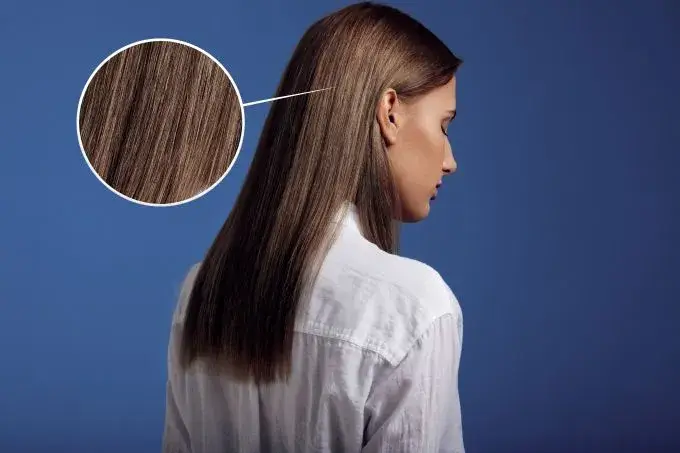


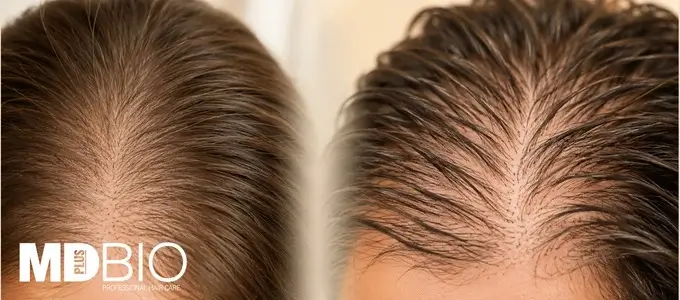
Hair density and hair thickness are often treated as if they mean the same thing, but they describe two different characteristics. Hair density is the number of hairs growing within a defined area of the scalp. Hair thickness refers to the diameter of each individual hair fibre.
A person can therefore have many fine hairs, relatively few coarse hairs, or any combination in between. Understanding which feature is making the hair look less full is important because products and treatments do not affect them in the same way.
Volumising products can make fine strands appear fuller, but they do not create new follicles. Medical treatment may improve density in some forms of hair loss, but it cannot turn every genetically fine strand into permanently coarse hair. This guide explains how to distinguish the two, how clinicians assess thinning, which options have credible evidence, and what results are realistic.
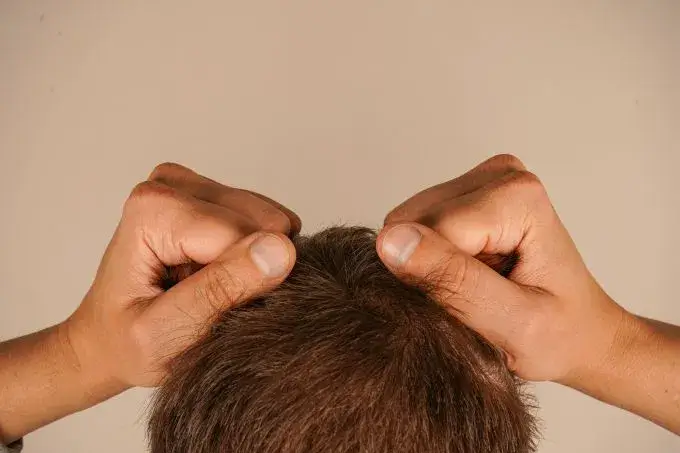
Hair Density and Hair Thickness: The Essential Difference
Each visible hair is a keratin fibre produced by a follicle. Density describes how many fibres emerge from a defined area of the scalp and is commonly expressed as hairs per square centimetre.
Thickness describes the width, or diameter, of one hair fibre and is usually measured in micrometres.
These characteristics work together to determine how full the hair appears. High-density fine hair may still lie flat, while coarse strands can provide substantial coverage even at a lower count. Curl pattern, hair colour, scalp contrast, styling and fibre damage also influence the visual result.
In pattern hair loss, follicles gradually miniaturise and produce finer, shorter hairs. As a result, both visible density and average shaft diameter may decline. Trichoscopy studies identify variation in hair diameter as a common sign of androgenetic alopecia, while phototrichogram studies also show reductions in density and diameter in female pattern hair loss.
Feature | Hair density | Hair thickness |
What it means | Number of hairs in a defined scalp area | Diameter of an individual hair fibre |
Common description | Dense, medium-density or sparse | Fine, medium or coarse |
What can reduce it | Pattern hair loss, shedding disorders, scarring alopecia, alopecia areata or traction | Genetics, follicle miniaturisation, ageing and fibre weathering |
What cosmetics can do | Conceal visible scalp or create temporary lift | Coat or condition fibres so they feel fuller and break less |
What cosmetics cannot do | Reliably create new follicles or treat alopecia | Permanently alter genetically determined follicle size |
How to Tell Whether Your Hair Is Fine or Low in Density
A Simple Check at Home
Examine clean, dry hair in consistent lighting. A widening part, greater scalp visibility or a smaller ponytail circumference may suggest reduced density, especially if these are changes from your usual baseline.
Take photographs from the same angles, distance and lighting every four to eight weeks. These comparisons are more useful than checking the mirror every day.
To consider strand diameter, gently roll one clean strand between two fingers. A strand that is difficult to feel is likely fine, while one that is clearly perceptible may be medium or coarse.
This is only a rough comparison. Do not diagnose hair loss from a strand test or from wash-day shedding alone.
What a Professional Assessment Adds
A dermatologist can examine the pattern of hair loss, the condition of the scalp and the variation between terminal and miniaturised hairs.
Trichoscopy uses magnification to look for differences in hair diameter, broken hairs, inflammation or scaling, changes in follicular openings, and signs associated with particular forms of alopecia.
A phototrichogram can measure density, diameter and hair-growth-cycle characteristics from standardised images. These methods are especially helpful when changes are subtle or need to be monitored over time.
Depending on the person’s history, a clinician may investigate iron deficiency, thyroid disease, illness, medication, hormonal changes or nutritional restriction. Tests should be guided by the clinical assessment rather than ordered as a universal hair panel.
Seek prompt medical advice for sudden or patchy loss, scalp pain, marked redness or scaling, pustules, eyebrow loss, or smooth and shiny areas where follicular openings appear absent. Early diagnosis can be important in these situations.

Options for Low Hair Density
Treatment begins with the cause. Low density is a description, not a diagnosis, and the right plan for hereditary pattern hair loss differs from the approach used for telogen effluvium, alopecia areata, traction alopecia or a scarring disorder.
Androgenetic Alopecia
Topical minoxidil is an established option for male and female pattern hair loss. It may stimulate growth and help maintain existing hair, particularly when treatment begins early.
It does not work for everyone and cannot restore a completely bald scalp. Continued use is generally required to maintain any improvement.
Formulations and directions vary by product, sex and market. Follow the relevant product instructions and seek professional advice when needed.
Prescription treatment may be appropriate after diagnosis. Finasteride is used for male pattern hair loss, while clinicians may consider other oral medicines for selected patients. Indications, contraindications and pregnancy precautions differ.
Low-dose oral minoxidil is used off-label for hair loss and requires medical supervision because systemic adverse effects can occur.
Low-level light therapy, platelet-rich plasma, microneedling and hair transplantation may also form part of an individual plan. Evidence and protocols vary. Some studies suggest that microneedling combined with minoxidil may improve density and diameter more than minoxidil alone, but home needling should not be considered equivalent to a controlled clinical procedure.
Diffuse Shedding and Other Causes
Telogen effluvium commonly causes increased shedding after a physical or emotional stressor. The priority is to identify and address the trigger, after which recovery follows the hair cycle gradually.
Supplements can be useful when a clinically relevant deficiency has been confirmed. High-dose supplementation is not a general treatment for low density, and excessive intake of some nutrients can be harmful.
Traction-related hair loss requires reducing sustained pulling from hairstyles or extensions.
Alopecia areata and scarring alopecias require medical diagnosis and condition-specific treatment. A volumising shampoo cannot replace this care.
Goal or finding | Possible approach | Evidence and limitations |
Early pattern thinning | Topical minoxidil after confirming suitability | Established option; response varies and continued use is usually needed |
Male pattern hair loss | Clinician-guided medicines such as finasteride | Effective for suitable patients; risks and contraindications require review |
Deficiency-related shedding | Correct the confirmed deficiency and its cause | Helpful when a deficiency exists; supplements do not increase density indiscriminately |
Fine or weathered fibres | Conditioner, reduced heat, gentle handling and temporary volumisers | Can improve feel, breakage and appearance, but not follicle number |
Advanced stable hair loss | Hair transplantation after specialist assessment | Redistributes existing follicles; donor supply and achievable coverage are limited |
How to Care for Fine Hair
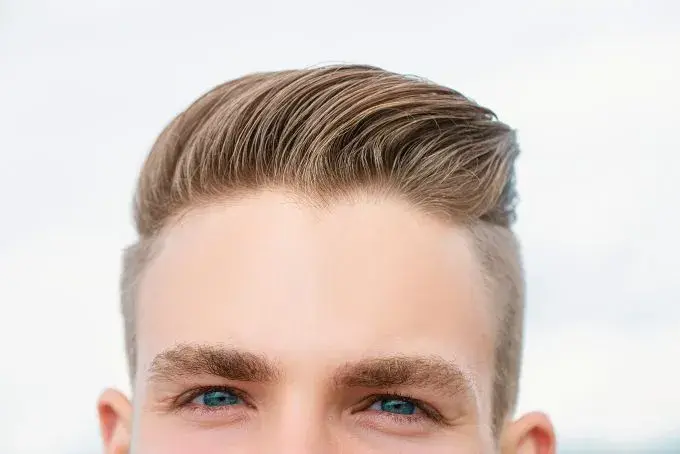
Naturally fine hair is not a disease. The practical goal is usually to protect the fibres and maximise volume without weighing the hair down.
Use a suitable shampoo on the scalp and apply a lightweight conditioner mainly through the lengths. Conditioning can reduce friction and breakage.
Limit high heat, aggressive bleaching, tight hairstyles and rough towel-drying. Use a wide-tooth comb and heat protection when appropriate.
Volumising mousses, sprays and polymers can coat the fibres or increase the space between them, creating a fuller appearance until the next wash.
Root-lifting techniques and a suitable haircut can enhance this effect. Fibre-thickening technology may increase the diameter of existing strands, but this is a cosmetic change rather than follicular regrowth.
Hydrolysed proteins and conditioning agents may temporarily improve the feel of damaged hair. They do not permanently rebuild the non-living shaft. Claims that a rinse-off product activates dormant follicles should be treated cautiously unless robust human studies support the complete formulation.
Volumising Products and Hair-Loss Treatments Have Different Roles
The terms “thickening” and “densifying” can refer to two very different outcomes. A volumising cosmetic acts on existing fibres and may create an immediate visual effect. A medicine intended for a diagnosed form of alopecia acts at scalp or follicle level and usually requires several months before its effect can be assessed.
Cosmetics can still be useful. Removing build-up, conditioning fragile fibres and reducing breakage can improve the overall appearance of the hair. However, styling volume is not evidence that the number of hairs has increased.
Higher-quality studies use objective measurements such as hair counts or fibre diameter, include appropriate controls and assess the finished formulation. Evidence concerning one ingredient does not automatically prove that every product containing it will produce the same result.
Where MD Plus Bio Hair Repair Shampoo May Fit
MD Plus Bio Hair Repair Shampoo is a 150 ml cosmetic shampoo intended to cleanse the scalp and support the cosmetic care of weak, brittle or thinning-looking hair. Its current product page lists panthenol, biotin, beta-glucan, aloe vera, hydrolysed keratin and collagen, Capixyl, piroctone olamine, Centella asiatica, amino acids and botanical extracts. Conditioning ingredients may help reduce breakage and give the fibres a fuller feel, while piroctone olamine may support the cosmetic management of dandruff and scalp build-up. The shampoo is not equivalent to minoxidil, finasteride or another medical treatment for alopecia, and it does not create new follicles. According to the product directions, it should be applied to wet hair, massaged in and rinsed; during the second application, it should remain on the hair for at least five minutes. It is for external use only, is not suitable for children under three, and should be discontinued if irritation occurs.
Safety and When to Seek Medical Advice
When possible, test a new cosmetic product on a small area before adding it to your routine. Stop using it if persistent burning, redness, swelling or a rash develops.
Do not use a dermaroller on an infected, inflamed, sunburned or otherwise damaged scalp, and never share the device. Poor technique or hygiene may cause irritation, bleeding, infection or unwanted changes in pigmentation.
After hair transplantation, follow the transplant team’s timing instructions before applying active products, rubbing the recipient area or using microneedles. Newly treated scalp should not be managed like ordinary intact skin.
Pregnant or breastfeeding people, children and those taking prescription medication should seek professional advice before using medicated hair-loss products or ingredients that have not been adequately studied for their situation.
Topical minoxidil may cause irritation and unwanted facial hair. Chest pain, faintness, a rapid heartbeat or swelling require urgent medical assessment.
The distinction is straightforward: products that improve cleansing, manageability, fibre feel or temporary volume provide cosmetic care. A condition that changes follicle activity or destroys follicles requires medical assessment and, where appropriate, evidence-based treatment.
Conclusion
Hair density describes how many hairs grow within an area, while hair thickness describes the diameter of each strand. Both influence coverage, but they require different strategies.
Fine but healthy hair may benefit from lightweight care, gentle handling and volumising products. A genuine reduction in density requires investigation of the cause and, when indicated, treatment based on a diagnosis.
Cosmetics can improve the look and feel of the hair, but a fuller appearance does not mean that new follicles have formed or that alopecia has been treated.
Discover the MD Plus Bio Range
Explore Hair Repair Shampoo and other MD Plus Bio products designed for the cosmetic care of the hair and scalp.
If thinning is persistent, sudden or accompanied by scalp changes, seek advice from a dermatologist.