


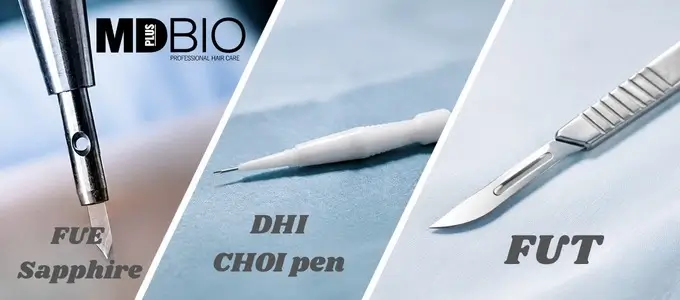
Choosing between the different hair transplant types can feel confusing, particularly when clinics use terms such as DHI, FUE and FUT without clearly explaining how they differ.
All three options aim to move healthy hair follicles from a donor area—usually the back and sides of the scalp—to areas affected by thinning or baldness. However, they differ in how the grafts are extracted, how they are implanted, the type of scarring they produce and the recovery experience.
This DHI, FUE vs FUT hair transplant comparison explains the essential differences in clear terms so that you can better understand which technique may be suitable for your hair loss pattern, donor capacity and aesthetic goals.
What Is the FUE Hair Transplant?
Follicular Unit Excision, commonly known as FUE, involves extracting follicular units individually from the donor area using small surgical punches. Each follicular unit may contain one or several hairs.
After extraction, the grafts are prepared and implanted into carefully planned recipient sites. The hairline design, graft distribution, density and direction are determined according to the patient’s facial proportions, hair characteristics and degree of hair loss.
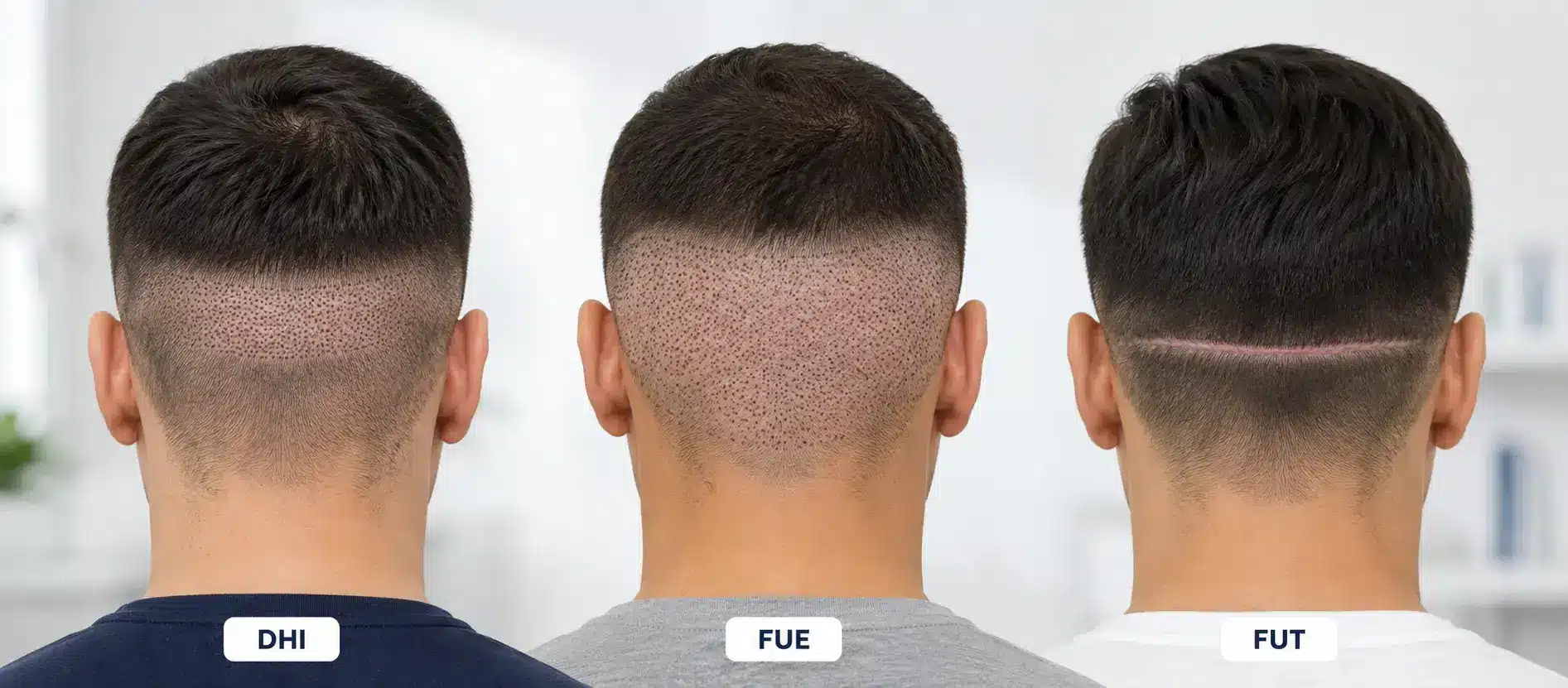
Because FUE removes grafts individually, it does not create the long linear scar associated with strip surgery. However, describing FUE as completely scar-free would be inaccurate. It normally leaves many small, scattered, dot-like marks in the donor area, which are generally difficult to notice when extraction is performed carefully and the donor hair is kept at an appropriate length.
FUE is commonly selected because it offers:
- No linear donor scar
- Greater flexibility for shorter hairstyles
- Individual graft selection
- A relatively comfortable recovery
- The possibility of using beard or body hair in selected cases
The International Society of Hair Restoration Surgery explains that FUE typically uses small punches to remove individual follicular units from the donor area.
What Is a DHI Hair Transplant?
DHI, or Direct Hair Implantation, is often described as a separate hair transplant method. Technically, however, DHI usually refers to an implantation approach used together with individually extracted grafts.
During a DHI procedure, follicles are generally extracted using the FUE technique. They are then implanted with a pen-shaped implanter. This tool can help the medical team control the placement, angle, direction and depth of each graft.
The International Society of Hair Restoration Surgery notes that DHI is not a fundamentally separate extraction method. The term is commonly used to describe immediate implantation or the use of an implanter device.
DHI may be particularly useful for:
- Hairline restoration
- Adding density between existing hairs
- Treating smaller or precisely defined areas
- Procedures requiring detailed control of implantation angles
- Selected no-shave or partially shaved procedures
DHI does not automatically guarantee better results than standard FUE implantation. The final outcome depends more heavily on diagnosis, surgical planning, donor management, graft handling, hairline design and the experience of the medical team.
FUT Strip Method Explained
Follicular Unit Transplantation, or FUT, is also known as the strip method. During FUT, the surgeon removes a narrow strip of hair-bearing skin from the donor area. The strip is then divided under magnification into individual follicular units for transplantation.
The donor area is closed with sutures or staples, resulting in a linear scar across the back of the scalp.
FUT was widely used before FUE became the preferred option in many modern clinics. It can still be considered in certain cases, particularly when a surgeon wants to obtain a large number of grafts while preserving other parts of the donor area for possible future procedures.
Its main disadvantages include:
- A permanent linear scar
- More tightness or discomfort in the donor area
- A longer initial healing period
- Restrictions on very short hairstyles
- The need for sutures or staples
FUT is not universally obsolete, and clinical guidelines for the procedure continue to exist. Nevertheless, FUE is now more commonly preferred by patients seeking less visible donor scarring and greater hairstyle flexibility.
DHI, FUE vs FUT: Procedure Differences and Similarities
Feature | DHI | FUE | FUT |
Graft extraction | Individual follicles, usually using FUE | Individual follicles | A strip of donor skin |
Implantation | Usually performed with an implanter pen | Grafts placed into prepared recipient sites | Grafts placed into prepared recipient sites |
Donor closure | No sutures | No sutures | Sutures or staples |
Typical scarring | Small scattered dot scars | Small scattered dot scars | Linear scar |
Short hairstyle suitability | Generally suitable | Generally suitable | Less suitable |
Large treatment areas | Possible but may take longer | Commonly suitable | Can provide many grafts in one session |
Density work between existing hair | Often advantageous | Possible with careful planning | Possible with careful planning |
Recovery | Usually relatively quick | Usually relatively quick | Typically longer |
Final growth timeline | Approximately 12 months or longer | Approximately 12 months or longer | Approximately 12 months or longer |
Comparing Recovery Times
Recovery varies according to the number of grafts, the patient’s healing response, the size of the treated area and the surgical protocol.
After DHI or FUE, small crusts usually form around the implanted grafts. Redness, mild swelling and temporary donor sensitivity may also occur. Most patients can return to non-strenuous daily activities within several days, although the scalp may still appear visibly treated during the early healing period.
FUT recovery may involve additional donor-area tightness because a strip of tissue has been removed and the incision has been closed. Patients must also follow their surgeon’s instructions regarding wound care and suture removal.
Regardless of the technique, transplanted hairs commonly shed during the first few weeks. This does not normally mean that the follicles have been lost. New growth develops gradually, and complete results may take approximately one year or longer to become visible.
Scarring and Aesthetic Outcomes
Every surgical hair transplant produces some degree of scarring.
FUE and DHI generally leave small circular scars distributed across the donor area. They are usually less noticeable than a single continuous scar, especially when extraction is evenly distributed and donor management is conservative.
FUT creates a linear scar. It may remain concealed beneath longer hair, but it can become visible when the hair is cut very short.
The extraction method alone does not determine how natural the result will look. Aesthetic outcomes depend on:
- Appropriate hairline positioning
- Correct implantation direction and angle
- Strategic use of single-hair grafts
- Realistic density planning
- Proper donor-area management
- Protection of existing natural hair
A poorly planned DHI procedure can look less natural than a well-planned FUE or FUT procedure. Technique is important, but clinical judgment and execution are more important.
Cost Differences Between DHI, FUE and FUT
Hair transplant costs vary considerably between countries and clinics. Prices may be calculated per graft, per session or as part of an inclusive treatment package.
Cost Factor | DHI | FUE | FUT |
Procedure time | Often longer for detailed implantation | Depends on graft number | May be efficient for harvesting many grafts |
Equipment and staffing | Implanter devices and a trained team may increase costs | Specialist extraction equipment required | Requires strip dissection and microscopic graft preparation |
Typical market position | Often marketed at a higher price | Commonly offered at mid-to-premium prices | Sometimes less expensive |
Main cost influence | Graft number, complexity and implantation plan | Graft number and extraction difficulty | Strip size, graft preparation and surgical expertise |
The cheapest option is not necessarily the most appropriate. A safe procedure should include a proper diagnosis, doctor-led planning, conservative donor management, qualified surgical personnel and structured aftercare.
Choosing the Right Hair Transplant Procedure
The right procedure should be selected according to your individual anatomy rather than the popularity of a particular term.
Patient Priority | Procedure Often Considered |
Wants to wear very short hair | FUE or DHI |
Needs precise hairline work | DHI or carefully performed FUE |
Requires implantation between existing hairs | DHI may be advantageous |
Needs broad coverage | FUE or, in selected cases, FUT |
Wants to avoid a linear scar | FUE or DHI |
Has limited donor capacity | Requires individualized planning rather than a technique-based decision |
Has had a previous transplant | Depends on existing scars and remaining donor supply |
A detailed consultation should evaluate the cause and progression of hair loss, donor density, hair calibre, scalp condition, age, medication history and the likelihood of future thinning.
Patients should also ask who will perform the surgical stages of the procedure. Professional organisations advise choosing a properly qualified and experienced hair restoration surgeon rather than making a decision based only on marketing claims or price. (nhs.uk)
Final Verdict: Is DHI, FUE or FUT Better?
There is no single technique that is best for every patient.
FUE is a versatile and widely used option that avoids a linear scar. DHI uses individually extracted grafts with an implantation approach that may offer additional precision in selected cases. FUT remains a recognised strip-harvesting technique but is chosen less frequently by patients who want to wear short hairstyles or avoid a linear scar.
The most important factors are accurate diagnosis, realistic planning, responsible donor use and natural graft placement. A personalised assessment is therefore more valuable than choosing a procedure based only on its name.