



The hair-care market includes everything from everyday shampoos designed for broad consumer appeal to specialist formulas developed for a particular scalp or hair concern. Although these products may contain some of the same familiar ingredients, their formulation priorities can be very different.
Commercial hair-care products are generally created to meet common needs such as cleansing, softness, fragrance, shine and ease of styling. Clinical-grade products are developed with a more specific purpose, such as supporting scalp balance, reducing breakage, strengthening weakened hair or improving the appearance of thinning hair.
The real difference is therefore not simply where a product is sold or how much it costs. It is why the formula was developed, how its ingredients work together, how it is manufactured and whether its claims are supported.
What Are Commercial Hair-Care Products Designed to Do?
Most commercial shampoos, conditioners and styling products are designed for frequent use by a broad audience.
Their priorities commonly include:
- effective cleansing
- pleasant texture and fragrance
- easy rinsing and styling
- softness and shine
- compatibility with different hair types
- accessible pricing and widespread availability
These are legitimate and useful cosmetic functions. A well-formulated commercial shampoo may be an excellent option for routine cleansing, while a mass-market conditioner can reduce friction, improve manageability and make damaged hair look smoother.
However, a product developed for the widest possible audience may not be designed to address a specific combination of scalp and hair concerns. Its formulation may focus primarily on sensory qualities, immediate cosmetic results or a recognisable headline ingredient.
This does not mean that commercial products are necessarily poor quality. It means their main purpose is often different from that of a specialist, clinical-grade formula.

What Does “Clinical Grade” Mean in Hair Care?
Clinical-grade hair care generally refers to products developed with a targeted, evidence-informed formulation approach.
Rather than focusing mainly on cleansing, fragrance or immediate softness, a clinical-grade formula may be created to support a defined concern involving the scalp, hair fibre or appearance of thinning hair.
A credible clinical-grade formula may be evaluated according to:
- the specific scalp or hair concern it is designed to support
- the scientific rationale behind its ingredients
- the suitability of its active combinations
- the compatibility of active and supporting ingredients
- formulation stability and preservation
- manufacturing consistency and microbiological controls
- safety assessment and appropriate testing
- claims that accurately reflect the product’s intended purpose
The words “professional,” “clinical” or “medical-inspired” alone do not establish quality. They become meaningful when supported by a defined purpose, relevant testing and controlled manufacturing.
Regulatory Status and Clinical Testing
In the United States, the FDA generally regulates a product as a cosmetic when it is intended to cleanse, beautify or alter appearance. If a product is intended to treat a disease or affect the structure or function of the body, it may instead be regulated as a drug or as both a cosmetic and a drug.
Most conventional cosmetic products and cosmetic ingredients do not undergo FDA premarket approval. Color additives are the principal exception. Manufacturers are nevertheless legally responsible for product safety and appropriate safety substantiation.
Regulatory status, clinical testing and medical purpose should therefore be understood as related but distinct aspects of product quality. Together with ingredient selection and manufacturing controls, they provide a more meaningful basis for comparison than packaging or retail channel alone.

Purpose-Led Formulation vs Broad Consumer Formulation
One of the clearest differences between specialist and general commercial hair care is the starting point of the formulation process.
A broad consumer shampoo may begin with questions such as:
Does it cleanse effectively? Does it foam easily? Does the hair feel soft after washing? Is the fragrance appealing?
A purpose-led formula asks additional questions:
Which scalp or hair concern is being addressed? Which combination of ingredients is appropriate for that purpose? Should the product be rinsed off or left on the scalp? How will the formula remain stable? What results can realistically be expected?
Factor | General commercial hair care | Clinical-grade hair care |
Primary aim | Broad cleansing, conditioning and sensory appeal | Targeted support for defined scalp and hair concerns |
Target user | Wide consumer audience | Users seeking a more specific hair-care routine |
Ingredient strategy | Familiar ingredients selected for broad use and price targets | Active combinations selected according to the intended purpose |
Product format | Often prioritises convenience and general appeal | Format selected according to contact time and intended use |
Claims | Frequently centred on appearance and sensory results | Expected to be specific and proportionate to testing and evidence |
Manufacturing | Quality standards vary between brands | Greater emphasis on documented manufacturing and quality controls |
This is not an absolute division. Some commercial products are supported by sophisticated formulation work, while some expensive professional products rely heavily on presentation.
The category name alone does not determine quality. What matters is the complete product behind it.

Why the Ingredient List Is Only the Beginning
Consumers often compare products by looking for ingredients such as biotin, panthenol, peptides, keratin, botanical extracts or piroctone olamine.
This can be useful, but an ingredient list cannot explain everything about how a product will perform.
Two products may feature the same headline ingredient yet behave differently because of differences in:
- concentration
- raw-material quality
- pH
- solubility
- supporting ingredients
- product stability
- preservatives
- packaging
- contact time
- directions for use
The vehicle carrying an ingredient can substantially influence its stability, release and delivery. Formulation therefore matters alongside the identity of the ingredient.[4]
Product format is also important.
A standard shampoo is rinsed away after a relatively short contact period. Its realistic functions usually centre on cleansing, scalp care and hair-fibre conditioning.
A leave-in serum remains in contact with the scalp for much longer. It can therefore be developed with a different ingredient system and a more targeted scalp-support purpose.
This is why two products containing similar ingredients may not offer the same experience or perform the same role within a hair-care routine.
Concentration Matters, but Higher Is Not Automatically Better
Clinical-grade products are sometimes described as superior because they contain higher concentrations of active ingredients.
Concentration can be relevant, but it is only one part of formulation quality.
An ingredient must be present at an appropriate level, remain stable, work compatibly with the rest of the formula and be suitable for the product’s intended contact time. Increasing the concentration may sometimes increase irritation without producing a better result.
The more useful question is not simply, “Which product contains the most?”
It is, “Does the product contain an appropriate amount for its intended function, within a stable and well-tolerated formulation?”
This principle is especially important when comparing cosmetics with medicines. Topical minoxidil, for example, has been evaluated in clinical research for androgenetic alopecia. Its evidence cannot automatically be transferred to a cosmetic shampoo or serum simply because the cosmetic is also marketed to people concerned about hair thinning.
Clinically Studied Ingredients vs a Clinically Tested Product
A product may contain ingredients supported by scientific or clinical research. However, evidence relating to an individual ingredient and evidence relating to the complete product are not identical.
An ingredient may have been evaluated through laboratory research, a human trial or manufacturer-sponsored testing. These findings can help explain why the ingredient was selected, but they do not prove that every formula containing it will produce exactly the same result.
Evidence type | What it may indicate | Main limitation |
Laboratory research | A possible biological or cosmetic mechanism | Does not establish real-world results in people |
Animal research | Early information about effects or safety | Results may not translate directly to humans |
Small human study | Preliminary information in users | Bias, size and study design may limit conclusions |
Randomised controlled trial | Stronger comparative evidence | Quality depends on size, duration and methodology |
Systematic review or meta-analysis | Overall findings across several studies | Depends on the quality and similarity of included research |
Finished-product testing | Performance of the actual formulation | Applies to the tested formula and conditions of use |
Reviews of cosmetic and cosmeceutical ingredients show that the strength of supporting evidence varies considerably. Some popular ingredients have human data, while others are supported mainly by laboratory findings or manufacturer research.[5]
Product communication should therefore distinguish between a studied ingredient, a clinically tested finished formula and a regulated medicine.

Why Quality Control Matters
Ingredient selection is only one part of product quality.
Raw-material checks, correct measurements, preservation, microbial control, batch consistency, packaging and storage all contribute to the safety and reliability of a finished formula.
In Great Britain, cosmetic products require a safety assessment before being made available to consumers. The Responsible Person must maintain a Product Information File containing information that includes the safety assessment, manufacturing method and evidence of good manufacturing practice.[2]
ISO 22716 provides international guidance for cosmetic good manufacturing practices. It covers production, control, storage and shipment.[3]
A documented GMP system does not prove that a product will create a particular result for every user. However, it demonstrates that manufacturing quality is being managed systematically and that processes are in place to reduce contamination, inconsistency and production errors.
For a clinical-grade brand, this manufacturing discipline is an important distinction from formulas whose perceived value rests mainly on fashionable ingredients, fragrance or premium packaging.
MD Plus Bio’s Clinical-Grade Approach
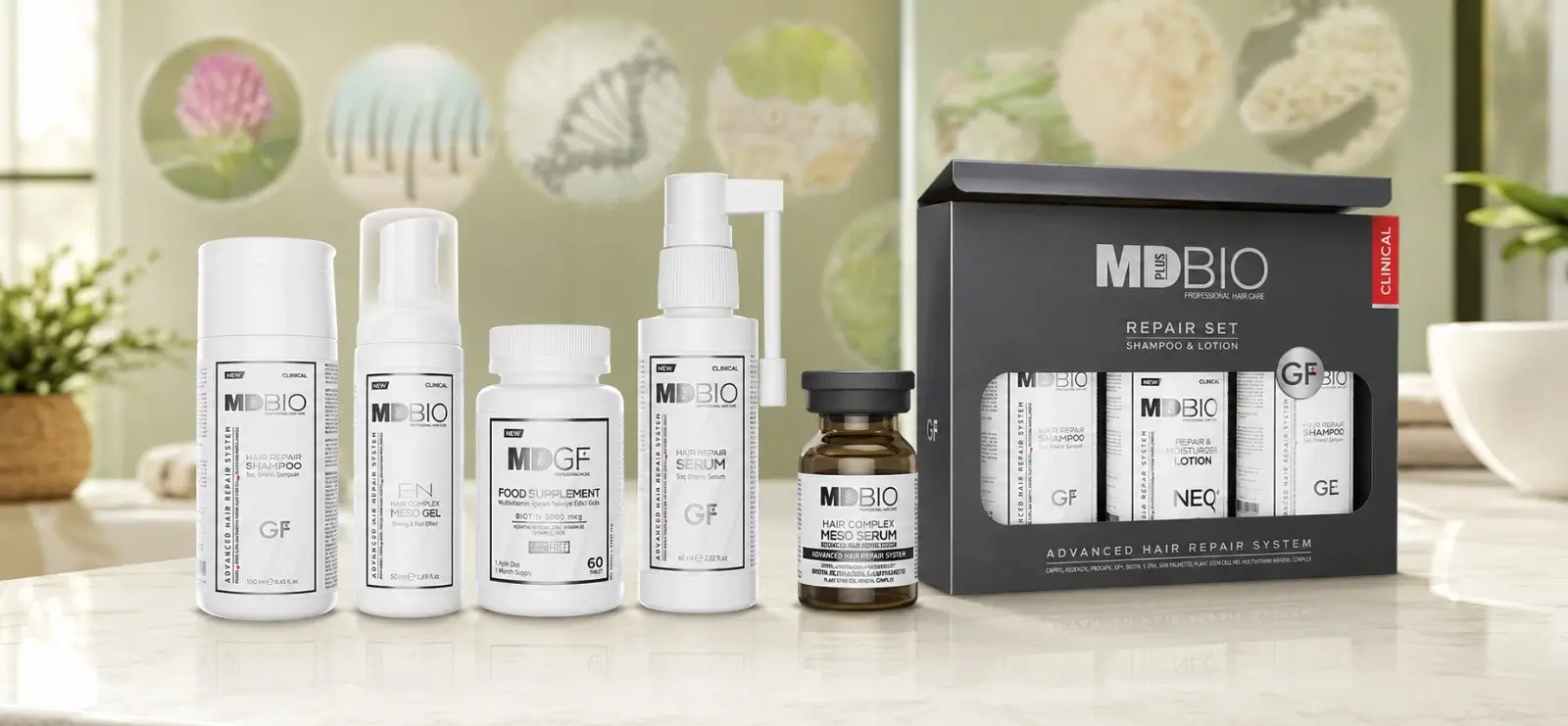
MD Plus Bio products are specialist formulas developed for people seeking more targeted scalp and hair support than a basic commercial cleansing routine alone.
The product range is clinically tested and FDA approved. Its formulations are created in advanced laboratories using pharma-grade raw materials, specialised active ingredients and herbal extracts that meet European standards.[6]
MD Plus Bio also states that its manufacturing systems include:
- ISO 9001
- ISO 22000
- ISO 22716
- ISO 13485
- Turkish Ministry of Health GMP certification
The company’s quality-control processes extend from raw-material intake through formulation, production, packaging and shipment.[3][6]
These credentials support the brand’s clinical-grade positioning by connecting targeted ingredient selection with controlled and traceable manufacturing.
How the MD Plus Bio Formulas Differ from General Commercial Products
The MD Plus Bio Hair Repair Shampoo combines everyday cleansing and conditioning functions with ingredients selected for the care of weakened, fragile or thinning-looking hair.
Its listed ingredients include:
- panthenol
- biotin
- beta-glucan
- aloe vera
- hydrolysed keratin and collagen
- Capixyl
- piroctone olamine
- Centella asiatica
- selected botanical extracts
This formula illustrates an important difference between a purpose-developed product and one marketed mainly around a single fashionable ingredient.
Its intended value comes from the way different ingredient categories work together:
- cleansing ingredients help remove oil, residue and buildup
- conditioning ingredients support softness and manageability
- hydrolysed proteins support the feel and appearance of weakened hair fibres
- piroctone olamine supports dandruff and scalp-buildup control
- moisturising and soothing ingredients support scalp comfort
- peptide-containing complexes and botanical extracts complement the targeted formulation
The shampoo remains a rinse-off product, so its benefits should be described realistically. It can support cleansing, conditioning, scalp care and the appearance and feel of the hair, but it should not be presented as a guaranteed cure for androgenetic alopecia.
Within the wider MD Plus Bio routine, leave-in serums perform a different role because they remain on the scalp for longer. The value of using complementary formats comes from designing each product for its intended purpose rather than expecting one shampoo to provide every possible benefit.
Unlike general commercial formulas created mainly for cleansing, fragrance and sensory appeal, the MD Plus Bio range uses targeted formats and active combinations selected for specific roles in:
- scalp care
- hair strengthening
- reducing the appearance of excessive shedding
- supporting fuller and healthier-looking hair
- maintaining hair after a transplant
- complementing a structured professional hair-care routine
This allows the brand to offer a more specialised approach than products designed primarily for general daily cleansing.
Can Commercial Products Contain the Same Ingredients?
Yes. A commercial shampoo may also contain biotin, panthenol, keratin, peptides or botanical extracts.
These ingredients are not exclusive to professional brands.
The more important questions are how each ingredient is incorporated, why it was selected, how it interacts with the rest of the formula and whether the complete product was developed for a defined purpose.
A fashionable ingredient included mainly for label recognition does not necessarily make a general commercial formula comparable to a deliberately developed active system.
At the same time, consumers cannot reliably determine exact ingredient concentrations or formulation performance from the ingredient list alone. Meaningful comparisons should therefore consider the product’s full formulation, intended use, testing and manufacturing standards.
Do Clinical-Grade Products Produce Better Results?
There is no single answer that applies to every product or every user.
A commercial shampoo may be completely suitable for someone who only needs routine cleansing and conditioning. A clinical-grade product may offer greater value to someone seeking a more structured routine for weak hair, scalp imbalance, increased shedding or post-transplant care.
The potential advantage of a clinical-grade product lies in the combination of:
- a clearly defined purpose
- targeted ingredient selection
- suitable product format
- clinical testing
- controlled manufacturing
- realistic directions and claims
It does not come from price, packaging or professional terminology alone.
Clinical-grade products should also be used consistently and according to their instructions. Even a carefully developed formula cannot provide its intended support when used incorrectly or inconsistently.
How to Compare Clinical-Grade and Commercial Products
Before choosing between a specialist product and a commercial alternative, consider the following questions:
- What specific purpose is the formula designed for?
- Does the ingredient combination make sense for that purpose?
- Is the product rinsed off or left on the scalp?
- Are its claims realistic for its format and contact time?
- Has the finished product been appropriately tested?
- Are the manufacturing standards and quality controls documented?
- Does the company clearly explain how the product should be used?
- Is the formula suitable for the user’s scalp condition and hair-care needs?
- Is the higher price supported by formulation, testing or manufacturing differences?
A higher price may be justified when it reflects thoughtful formulation, specialised raw materials, quality-control systems and appropriate testing. Price alone, however, is never evidence of performance.

Safety and Appropriate Use
Both commercial and clinical-grade hair products can cause irritation or allergic reactions.
Stop using a product if persistent burning, swelling, redness or significant itching develops.
People with eczema, psoriasis, seborrhoeic dermatitis, scalp infections or unexplained inflammation should consider consulting a dermatologist before introducing new active products.
The same applies after a hair transplant or another procedure that temporarily disrupts the scalp barrier. In these situations, the treating clinician’s instructions should take priority over general product directions.